Showing posts with label Italy. Show all posts

Monday, November 28, 2016

Can you avoid tourist mayhem and still get the "Europe Experience"?


I've had stress on my mind a lot lately. It must be the holidays. I've also been going through our photos and videos from the last few years of traveling around Europe. The funny thing is, behind every one of the pictures and videos is a set of stories, some of them hectic, some of them more pleasant. As humans, we never like to show the hard times, only the good ones (isn't that the 'fun' of Facebook? :) ). While reflecting on these experiences, I realized that there were quite a few places to visit that purported to provide that classic European Travel Experience, but that were too exhausting to actually enjoy. Paris, Rome, London -- each of these were incredibly stressful, and we traveled during the offseason. Don't get me wrong, they're worth the visit and I wouldn't recommend skipping them altogether, but we just found that traveling as a family with 4 kids, there were more enjoyable, less exhausting experiences that still provided that uniquely European cultural experience.

So, with those happy memories brewing, we put together a new video on our favorite places to travel as a family in Europe--the places we definitely plan on going back to on our next visit. Watch the video (above) and get our two cents on each place below:

[OBLIGATORY SPOILER ALERT LINE, in case you haven't watched the video yet]
---------------------

5. Tarragona, Spain. 

The Mediterranean coast of Spain used to be a Roman settlement, and Tarragona has, perhaps, the best preserved sites. Add in the beautiful beaches, and this place was perfect. It was like being in Rome without the crowds, pick-pocketers, smelly subways...well you get it. No, it doesn't have Rome's splendor (we've done Rome, and there is no substitute) but we really enjoyed it as an ancient Rome experience. And what we enjoyed even more was how inexpensive it was to see it all.  We paid more for parking in a garage for the day than we did to visit all the Roman ruins. The Tarragona Family Card was under 50 Euro for the whole family, and we got admission to all the major Roman sites. Definitely worth it.

4. Black Forest, Germany.

Tour guides will tell you that Black Forest was therapeutic for those overburdened and facing stress-born illnesses. It only takes one visit to realize just how therapeutic the place is. A collection of beautiful Bavarian towns and throw in some waterfalls, an open-air museum, and, our favorite, a toboggan ride, and you'll not want to leave. People there are extremely accommodating as well. When we went, our AirBnB fell through and it didn't take much frantic searching before we found a place to accommodate us (and we have a family of 6!) Locals were happy to suggest homes and families we could talk to. Take a drive around the Black Forest for an enjoyable experience.

3. Rovinj, Croatia. 

Every stress-free trip list should feature a shanty beach town with beautiful views and ample places to relax, swim, etc. Rovinj is our favorite. We had originally booked a few days in Pula, but venturing 20 minutes into Rovinj made us realize that we had chosen the wrong place to stay. So much charm, and the local boat rides can be had for deep discounts if you ask, and if you travel in the offseason. Added bonus: the people of Croatia are incredibly hospitable. Some of the nicest people we met in Europe.

2. Lucca, Italy.

There's nothing big about Lucca. It's a small Italian town with the usual small Italian town delights. So why is it so high on our list? I don't know to be honest. We just really enjoyed it. Whether it was biking around the city walls or popping into a local pizzeria, it just felt like the complete Italian experience, minus the hubbub of tourists.

1. Salzburg, Austria.

Ok, we know what you're thinking: how can we put a major tourist destination atop this list?  Parking can be difficult in the city and there is a lot of foot traffic. But for us, the Salzburg Card made all the difference. For under 100 Euro, our family of 6 got to see all the best sites, plus we had full access to public transportation, making our visit to the city quite easy. Plus, how can you not feel relaxed in the city where the Hills are Alive with the Sound of Music.

Hope you enjoyed our list. Don't forget to subscribe to our YouTube Channel and leave a comment on places you'd like us to profile!

Thursday, August 25, 2016

Five European Side Trips to Get off the Tourist-Beaten Path

Tarragona, Spain
Even the most neophyte traveler knows to put the main attraction cities at the top of a list. Paris, Venice, London, and even Barcelona are full of them. But the adept traveler knows that just as much, if not more, wonderment can be had in the cities that aren't trampled by tourist Birkenstocks.

As a family of 6, we've put a lot of kms (and even more miles) into road tripping around Europe--more than 30,000 kms actually.  As much as we've enjoyed the Louvre, St. Mark's Square, Buckingham Palace, and the Sagrada Familia, we've found even more enjoyment in the side trips where local culture trumps consumerism.

1. Etretat, France - 2.5 hours from Paris
Let's be honest, you could pick any of the shanty towns on the northern coast of France and get a similar experience, but we picked Etretat because of its majestic cliffs. It has all the charm of a beach side village, the rustic shops, and laid-back lifestyle of fisherfolk and locals. It's also historically significant as a town where Van Gogh painted. And yet, it's relatively untouched as a tourist destination. When we visited in the Summer time (mid-June), the only "tourists" we could see were school kids on an outing.


2. Bassano del Grappa, Italy - 1 hour 15 min. from Venice
There are at least a dozen towns within an hour or two from Venice that are worth seeing, including Padua, Treviso, Cittadella, and even Romeo & Juliet's Verona. But we choose the smaller, but historically significant town that's equally as charming. As a historical visit, Bassano is where Ernest Hemingway served his tour of duty as an ambulance driver during World War I, and which served as an inspiration and backdrop for his classic A Farewell to Arms. Bassano also boasts some seriously beautiful views and a quirky but expansive weekend market that makes the visit even more worth it. It also has my kids' favorite place for Kebabs - Indiana (just down from the bridge).

3. Vicenza, Italy - 1 hour from Venice
So, it was impossible to pick just one side trip from Venice. If Bassano is the small town with the Italian local charm, Vicenza is the hidden gem with architectural splendor. Vicenza is the home of Venetian Architect Andrea Palladio, widely considered the most influential individual in the history of architecture. If Venice is the town Palladio built, then Vicenza was Palladio's playground. The town's center (which prohibits any tourist driving) features a plethora of picturesque places. Our favorite is the Teatro Olimpico, but the plaza and several other buildings are worth a visit, including Santa Corona, a Gothic Church that was built to house a thorn from Christ's Crown of Thorns given to the Bishop of Vicenza by Louis IX of France. 

Palladio's Teatro Olimpico
4. Tarragona, Spain - 1 hour from Barcelona
This Catalan city may not be the non-touristy hideaway that other places on this list are--it's the home to one of Spain's big theme parks, Port Aventura. But it certainly doesn't feel like a tourist-trodden town. Tarragona has the perfect mix of old Spanish town, ancient Roman stronghold, and beautiful beach. We liked Tarragona so much that no only are we doing an Expat Snippet video on it (stay tuned), but we're making it a regular visit on our Study Abroad trips to Barcelona each Summer. There's enough to see to spend a weekend in Tarragona, and what's more, it's extremely budget friendly. Tarragona boasts a set of intricately preserved Roman structures, including a forum, circus, and Roman walls. A family ticket to see all of them cost us 17 euro (!!).  Incredible views and easy on the pocketbook? Yes, please.


5. Oxford, England - 1 hour 20 minutes from London
Ok, so Oxford isn't exactly undiscovered country, but that doesn't make it any less worth a visit to get away from the maddening crowds of tourist-heavy London. Oxford is college-town, level-up--with superior architecture speckled all over the city, and nice access to the Thames. It's best to park outside the city at the Park n' Ride off the exit toward Oxford and take a Bus in, since parking is extremely limited. Christchurch is a good place to start, as it features the inspiration for Hogwarts' Great Hall, as well as the setting and inspiration for Lewis Carroll's Alice in Wonderland (as Carroll, born Charles Dodgson, was a student there and based Alice on the Dean of Christ Church's Daughter, Alice Lidell). 

Gryffindor!


Friday, August 12, 2016

Skip it or See it: Getting off the tourist-beaten path


Europe has its fair share of tourist traps, designed to charm your wallet empty with worthless and over-hyped activities. Over the past three years, we’ve spent extended stays in Italy and Spain, and seeing all the countries in between.  One thing we’ve learned living abroad is that there are two sides of Europe, the touristy Europe and the local Europe. While seeing the touristy things (like the Louvre in Paris, the Colliseum in Rome, etc.) can be fun enough, getting away from the crowds and experiencing Europe like a local can be much more rewarding. The result of our travels – this list of what to see and what to skip. Call this a volume 1, if you will.

Skip it: Expensive Gondola Ride in Venice
Truth be told, we’ve never taken a Gondola Ride in Venice, even though we spent 3 months living an hour from this tourist hot spot.  Sure, there is a lot to enjoy about Venice—it’s charm, it’s history…but it all comes at a steep cost: really expensive tourist traps. Gondola rides are probably number one on the list. One ride can cost you 80 euro, or close to $100, and to be honest, you can get the romantic charm of Venice in so many other experiences (a nighttime stroll in St. Marks when the tourists have gone vacated the area is one) without paying the high price of sitting in a gondola.

 See it: Venice’s Vaporettos
If you want to save money and still get the amazing views of the Venetian canals, take the Vaporettos. They’re basically water buses that travel on a regular schedule around the island of Venice and in and out of the canals. They also take people out to the outlying islands, including Murano, famous for its glass blowing.  The Vaporettos also have a stop at the most easily accessible free bathroom on Venice (in McDonald’s). And trust us, Venice is one of the most difficult places to find a free bathroom in Europe.

Skip it: Pisa, Italy
Yes, we know, it’s probably heresy to suggest someone would skip Pisa. Don’t skip Pisa, just don’t plan more than an hour there. It’s an unremarkable city with a football field size center where everything worth seeing, including the Leaning Tower, is all crammed in to one walled-off field. Yes it’s beautiful. Yes it’s touristy (battling the throngs of tourist shops and vendors on the way in is fun enough), and yes, you’ll take a ton of pictures, but you’ll have more fun in….

See it: Lucca, Italy
The real charm around Pisa is actually Lucca, an old but vibrant town surrounded by a large wall that serves as an exhilarating bike riding path. Lucca was also one of our favorite towns to get lost and explore in, with amazing local food and plaza markets. A must try is their Cecina, a brick-oven type pizza made of garbanzo beans, it’s delicious and quite inexpensive! Of course, you’ll take more pictures in Pisa, but you’ll have more fun in Lucca.


Skip it: Dublin, Ireland
We’ve seen the hype about Dublin and, yes, it’s a fairly easy city to walk around and it has its historical and cultural draw, but its cultural gems (the Book of Kells, St. Patrick’s, etc.) are hidden behind some pricey entrance fees, and the foot traffic and crowds are almost unbearable (and this is coming from a family who spends every Summer in metropolitan Barcelona).  

See it: Pretty much everything else in Ireland.
Ok, so much of the sites worth seeing cost some money in Ireland, but we definitely got more out of the sites outside of Dublin than walking through a cathedral or touring a several hundred-year-old copy of the Bible (both of which are still cool in their own right).  The best parts of Ireland are out on the coasts and country, especially the Cliffs of Moher, where you can spend an entire day enjoying the sea-carved cliffs. Driving the small backroads where two cars are supposed to fit on a one-lane road is also an adventure to say the least.

Skip it: Pula, Croatia
Ok, you’ve probably never heard of Pula, many haven’t. But it’s billed as a tourist destination for Roman ruins (they have their own Roman Colliseum) and beach-side views. Pictures do it much better than it actually is, in our opinion. However, we only mention Pula here because we really liked…

See It: Rovinj, Croatia

This town is the type of seaside fishing town you would see on postcards. There are beautiful coasts, islands, fun walks through the cobble-stone town, and plenty of places to jump in the sea and swim (with lots of fish to swim with). You can also get a pretty good deal on an inexpensive glass-bottom boat tour, especially if it’s in the off-season. 


Thursday, June 30, 2016

Livin' la Vida Loca: Going Expatriate with a Family


We've often been asked what it's like to bring a family of 6 to Europe--usually following an indirect inquiry about our sanity. So I thought it might be apropos to pen this blog post with the top six considerations of traveling and living in Europe.

Flexibility with Living Conditions
Across the board, living spaces in Europe are generally much smaller than they are in the U.S. Apartments tend to be two bedroom or less, and we have learned to fit all four of our kids in the same bedroom, using bunk beds, or putting some kids on a couch if necessary. Hotels may be a good alternative, but even they are much smaller than in the U.S. Shortly into our first expatriate experience, we finally gave up on finding an American-size hotel room that fit us all, and looked for multi-room bookings that were cheap enough to "vale la pena" (as they say in Spain).  While Booking.com seems to be a good resource for European hotels and homes, we have also had varying success with Ibis hotels. Their rooms are extremely small and basic (usually a bed, bathroom, shower all in 100 sq ft), but they're also extremely economical. 
Nice and Comfy!
Food
After traveling to so many countries, and living for long periods of time especially in Barcelona, we often have friends who ask for restaurant recommendations. Problem is, we don't go to any restaurants. I mean...we don't even go to restaurants in the U.S.--we have 4 kids. Not only is it pricey, but "Smith, Party of 6" isn't always the most relaxing dining experience. No, we don't do restaurants in Europe, especially since in many cities, the dining experience can be much longer (up to 2 hours or more). Instead, we do "Grocery Stores". Yep, Grocery Stores. Especially Aldi, Lidl, and Mercadona. I'm a firm believer that you learn a culture by its home-cooked meals, and grocery stores are the ground floor. We love to dive into the new and different foods, and we often let the kids choose what they want. Of course, some grocery stores are more difficult than others, esp. Croatia where we didn't have the advantage of an easily translatable romance language, and the Croatian Kuna has an uneven exchange rate against the euro and dollar. Either way, though, we've found that you can get the same, and sometimes better, food in grocery stores than restaurants, and it's always cheaper.   (Below, some favorite grocery foods in Italy and Spain)


Level Up on Going Green 
From meticulously dividing garbage into up to four different categories and putting out the right receptacles on the right day in Italy to paying for utilities in HomeAway and AirBnB rentals,  life in Europe can be much more conservation-minded than life in the U.S. Europeans like to save energy and live green. The value of conservation may even carry over to laundry, as few apartments in the places where we've lived (Spain and Italy) have had a dryer; and washing machines in Europe take 2-3 times longer than U.S. counterparts (up to 3 hours for a load to finish). But one thing we've learned, is that welcoming the change in lifestyle is actually something our kids have enjoyed--in fact, in Italy, hanging the laundry out became one of the coveted chores.
Chores, Level Up!

Going with the Locals 
Cheering on Spain with Barcelona locals during the FIFA Euro Cup, 2016
One of the most significant opportunities to grow has been interacting with locals while we're abroad. It's a chance for all of us (not just the children) to see from another's viewpoint and thereby broaden perspectives. For this reason, I always encourage my boys to jump into a futbol (i.e. soccer) game with local kids at a park. Whether it's been France, Spain, or Italy, the kids have always figured out how to work around the language differences--playing seems to have a language all its own. 
Futbol with locals outside in France

Playing is the Universal Language (Italy)
We have also religiously attended our church services on Sundays, no matter where we are. This has often meant staying for 2-3 hours of church services, depending on our travel schedule, even when we may not speak the same language as the congregation. In Spain, my fluency in Spanish has made it easier, but the more we've gone to Church, the more the kids figure out how to communicate and get around the language barrier, to the point that the oldest have often said they don't need me to translate for them, even though they don't speak Spanish. 

Travel
Despite what travel gurus like Rick Steves preach, the Euro Rail System is NOT inexpensive or frugal, especially with a family of 6. Inexpensive flights can be a good alternative--even commonly derided cheap airlines like RyanAir aren't as bad as billed, as long as you know the conditions/specifics of traveling with them. (EasyJet is particularly constricting on their carry-on baggage policies).  If booking a flight, don't fall into the "you can book flights once you get here" trap...it's best to plan ahead, as Euro flights, just like US flights, are much cheaper a month or two before your travel date. 

A good alternative is rental cars. Yes, they can be somewhat expensive (up to $100 a day) but renting from a carrier in an airport is cheaper, and car prices vary by country. Generally we found them to be more expensive in the UK, and extremely cheap in Spain ($50 for an entire weekend for a car that fits 7).  If you book online early enough, they can be the cheapest option for travel. Of course, if you drive, tolls and gas are worth examining (especially in France and Spain), but Michelin has a great website for figuring out travel costs. 

A few travel laws you'll need to keep in mind if you drive in Europe: 1) If you're renting in Switzerland, Austria, or Slovenia, make sure you get a highway "vignette" sticker, or you'll be slapped with a huge fine; 2) You will get caught speeding...by a camera. There are a ton in Europe. On the bright side though, the average speed highways can be fun (esp. in Italy where people driving sports cars sit on the side of the road for a few minutes just so they can push 120 MPH).  3) Make sure you follow traffic signs, especially the zone traffic limitato signs. Risking it just because you don't see a cop will lead to a steep fine (like I found out in Padova). There are cameras everywhere. 
Don't forget your Vignette Sticker!
Beware this sign


An important side-note on Europe travel is how walkable cities are. It's a blessing and a curse. Driving in large cities is difficult, and often forbidden (esp. in Italy), but it also means that everything is fairly close (or at least a 15-20 minute walk). Bonus: It's also the most enjoyable exercise in the world--amazing sites and cardio at the same time. It also means a lot more walking for kids who are used to taking a car everywhere. At least a month prior to our trips to Europe, we like to take long walks around our home in the U.S. to get them ready for the "Euro-Cardio". Also, we've found it essential to always bring water bottles when we go sight-seeing, whether it's hot or cold. Some  cities, even major ones (I'm looking at you Paris), have no public drinking fountains. Having a water bottle has not only saved us a few Euro, but it's also saved us a ton of frustration when kids get thirsty. (BTW, Barcelona is the overwhelming exception here, as there are fountains all over the city). 

Ahh, Euro Cities are so Walkable!
Sight-seeing
While we try to avoid the American tourist experience as much as possible, we also believe that sight-seeing can be both exciting and educational. In fact, we tend to see everything we can in an area (sometimes more than locals see).  Of course, sight-seeing with 4 boys can be difficult, especially when museum-meandering and architecture-admiring usually isn't on the top of their list. So, to engage them more, we invite our kids to choose a country, city, or location, and do the research about the area themselves, choosing where to go, what to see, and why to see it and put together a powerpoint presentation about it. This usually includes guided Internet research and at least one trip to the library (bonus).  We then reserve a night when they can officially present the idea to us, and when we visit the location, the child in charge gets to be the official tour guide, leading the visit, and talking about interesting historical, cultural, or other significant facts about the location. 

Most recently, this led to a weekend road trip around Catalunya, to the Roman ruins of Tarragona and the beach castles of Lloret de Mar and Tossa de Mar. 


Another thing we've found that works with endless sight seeing is to give the kids a travel journal, where they can draw some of the cool places we visit.


To be fair, sometimes living abroad has to involve the usual video-game playing and TV watching downtime for the kids, despite how much we, as adults, would rather spend every moment taking in the beauty of the culture around us. However, we've discovered it's a balance thing...downtime makes the sight-seeing easier to do and the kids more amenable to the activities. Not to mention, downtime can be a great motivator, especially when visiting cities where there's a lot of walking. 

Overall, expatriate life requires flexibility and, to be honest, isn't for everyone. Setting expectations, however, is the first step in ensuring a good experience for both parents and kids. 

Tuesday, December 2, 2014

TV in Italia

While not traveling in Europe we end up having down time to kill. Most of the time in the morning or while Curls is making dinner we decide to watch tv.

Most of our favorite shows are only available in Italian. It is really fun to watch Phineas and Ferb, Kung Fu Panda, Johnny Test and many others in Italian. Most of the time we just try to use context clues to figure out what is going on, or if we have seen the episode in English, try to remember the plot.

There is one show we can watch in Italy that's still in English: Mr. Bean (the cartoon). Because Mr. Bean only mumbles, they don't bother to translate it. This means they also don't translate the other English speaking characters. It feels like a little slice of home! We love Mr. Bean.

We're also able to watch some shows online still. Our personal favorite is Studio C on BYUTV. Every week we look forward to a new set of skit comedy sketches.

Thursday, October 30, 2014

Crazy Travel Weekend Day 2: Pisa and Lucca


After making the 4.5 hour drive to Siena the day before, we made our home base La Spezia which is only an hour from Pisa and Lucca, and is minutes from Cinqueterre. We started day two in Pisa. 

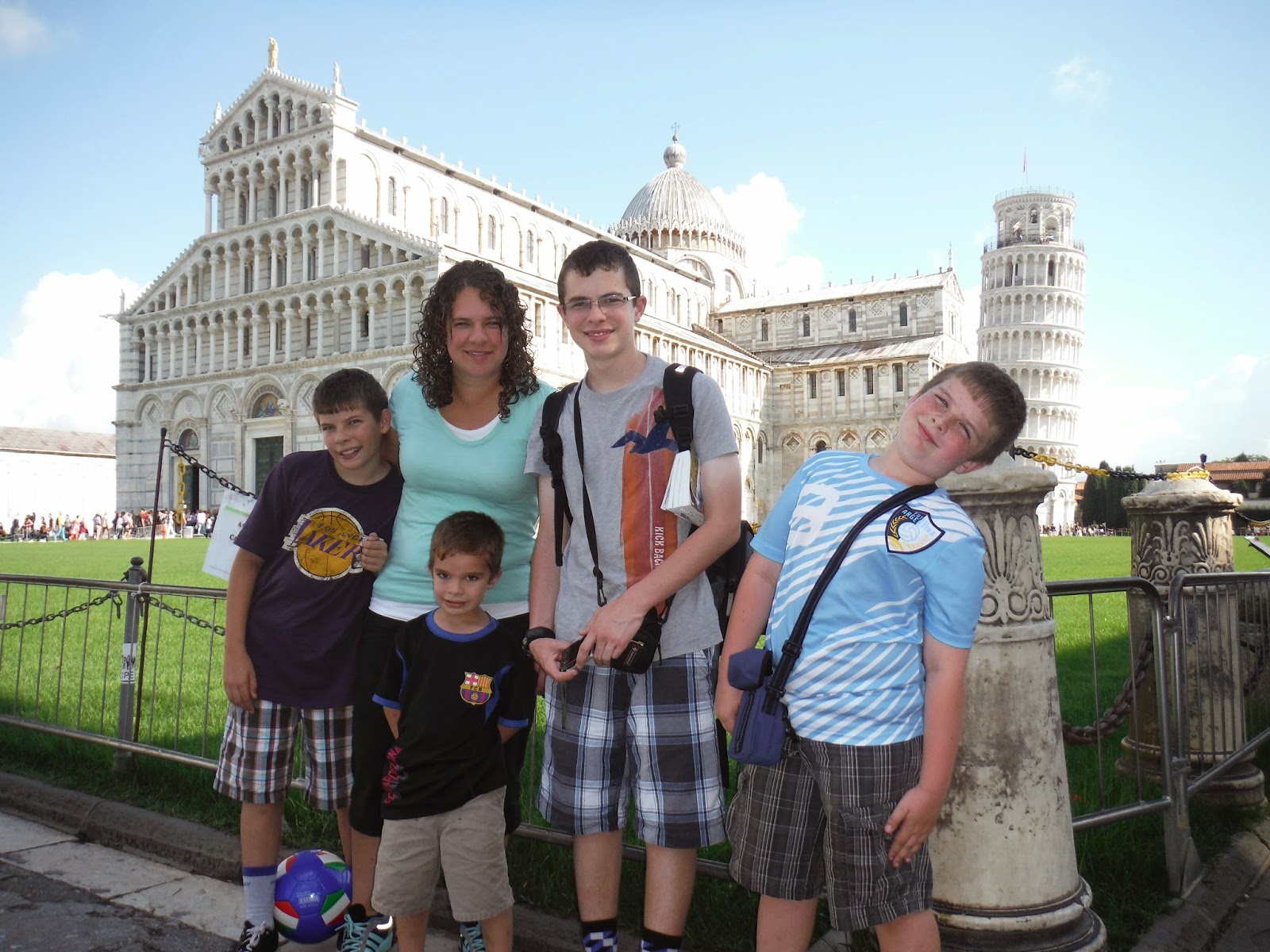
Over the course of our travels, we're always trying to see how much we can see in one day. We've proven big cities can be done in one day, but what about two cities? If you're seeing Pisa and Lucca, the answer is yes. In fact, the two cities are perfect for a one day visit. First, we started with Pisa. The nice thing about Pisa is that all there is to see is the Field of Miracles--the leaning tower and the adjoining buildings. It's also completely free, unless you actually want to go in the buildings, which we opted not to do. We had too much fun taking pictures around the buildings...including the must-do "holding the building up" shots (which pretty much everyone seems to do)


Then we took pics around the buildings. The thing about Pisa is that the sights in the Campo Di Milagros are simply breathtaking. We spent an hour just enjoying the 3 main buildings. In fact, they made a great place to sit and draw.


As a bonus, we found this cool fallen angel sculpture. Looks like The Doctor has been here...


To enjoy Pisa, you really only need an hour....unless you get stuck in the hoard of crowds and outdoor market vendors just outside the walled Field of Miracles area. After enjoying Pisa, we recommend heading over to Lucca. It's the typical Italian city, but with an added bonus: you can bike around the city on top of the ancient city walls. Bikes are relatively cheap to rent (about 3 euro), and the wall is an enjoyable sight-seeing tour. If you're looking to save money on bike riding, you can get around the city at a leisurely pace in about 30 minutes.


After biking the city, we followed Rick Steve's advice to get some Cecina in the city. We went to Rick's recommended location, and weren't the only ones. Much of the store was filled with Americans holding Rick Steve's books. The cecina, which is a garbonzo bean crepe, was as good as advertised...and it's a great deal. About 1.50 Euro a slice.  And in Lucca, Cecina isn't the only great food, they've got amazing Focaccia and other types of breads.

We also got to enjoy some of the sites in Lucca. Their churches are amazing, and we even got to enjoy a procession by youth in the city.


Overall, Lucca and Pisa make a great day of sight-seeing.